A laser appointment should begin with a periodontal examination, not with the laser itself. You will be able to identify the diagnostic checks, treatment steps, questions about alternatives, and follow-up care that distinguish a clinically justified procedure from a vague “laser” promise.
Key takeaways
- Expect gum measurements, X-rays, and a medical history before laser treatment.
- Ask what the laser will treat and whether scaling or surgery is also needed.
- Laser care does not replace daily brushing, interdental cleaning, or follow-up visits.
- Confirm the dentist’s periodontal experience, equipment, fees, and aftercare plan.
How does the dentist diagnose the gum problem before using a laser?
The dentist starts the laser gum treatment process in delhi with a periodontal assessment, not immediate laser use. They review your medical and dental history, medicines, diabetes or smoking status, symptoms, previous treatment, and the duration of bleeding, swelling, pain, or bad breath.
They inspect plaque and tartar, gum colour and swelling, exposed roots, ulcers, abscesses, and damaged tissue. A periodontal probe records pocket depths around each tooth in millimetres; the dentist also notes bleeding on probing, measures gum recession, and checks whether any tooth moves.
| Finding | What it suggests | Usual treatment direction |
|---|---|---|
| Plaque-related gingivitis | Inflamed gums without attachment or bone loss | Professional cleaning and improved plaque control |
| Periodontitis | Attachment loss, deeper pockets, and possible bone loss | Structured periodontal treatment; laser only if indicated |
| Gum abscess | Localised pus, swelling, and tenderness | Drainage, infection control, and possible root-canal or extraction referral |
| Recession, trauma, or another defect | Tissue loss or injury not caused by ordinary gingivitis | Cause-specific care, surgery, or specialist referral |
If bone loss, a deep defect, an impacted tooth, or another hidden cause is suspected, the dentist orders dental X-rays or a Digital OPG. “Gum infection” is not a sufficient diagnosis. The findings decide whether laser gum care in delhi is appropriate or whether conventional periodontal treatment, drainage, surgery, or an extraction referral is safer.
What are the laser gum treatment steps during the appointment?
1. The appointment begins with a review of your periodontal findings. The dentist identifies the proposed pockets or soft-tissue sites, explains alternatives such as scaling and root planing or surgery, and obtains informed consent.
2. You receive protective eyewear matched to the laser’s wavelength. Ask which laser is being used and why; a diode, Nd:YAG, and erbium laser do not perform identical tasks.
3. If the treatment area is sensitive, the dentist applies local anaesthetic. “Painless” is not a reliable promise, and anaesthesia helps prevent discomfort during deeper cleaning.
4. The dentist first removes plaque and hardened calculus with hand instruments or an ultrasonic scaler. Irrigation and cleaning beneath the gumline remain central to gum infection laser treatment. A laser cannot remove hardened calculus simply by being present, so ask whether scaling and root planing are included.
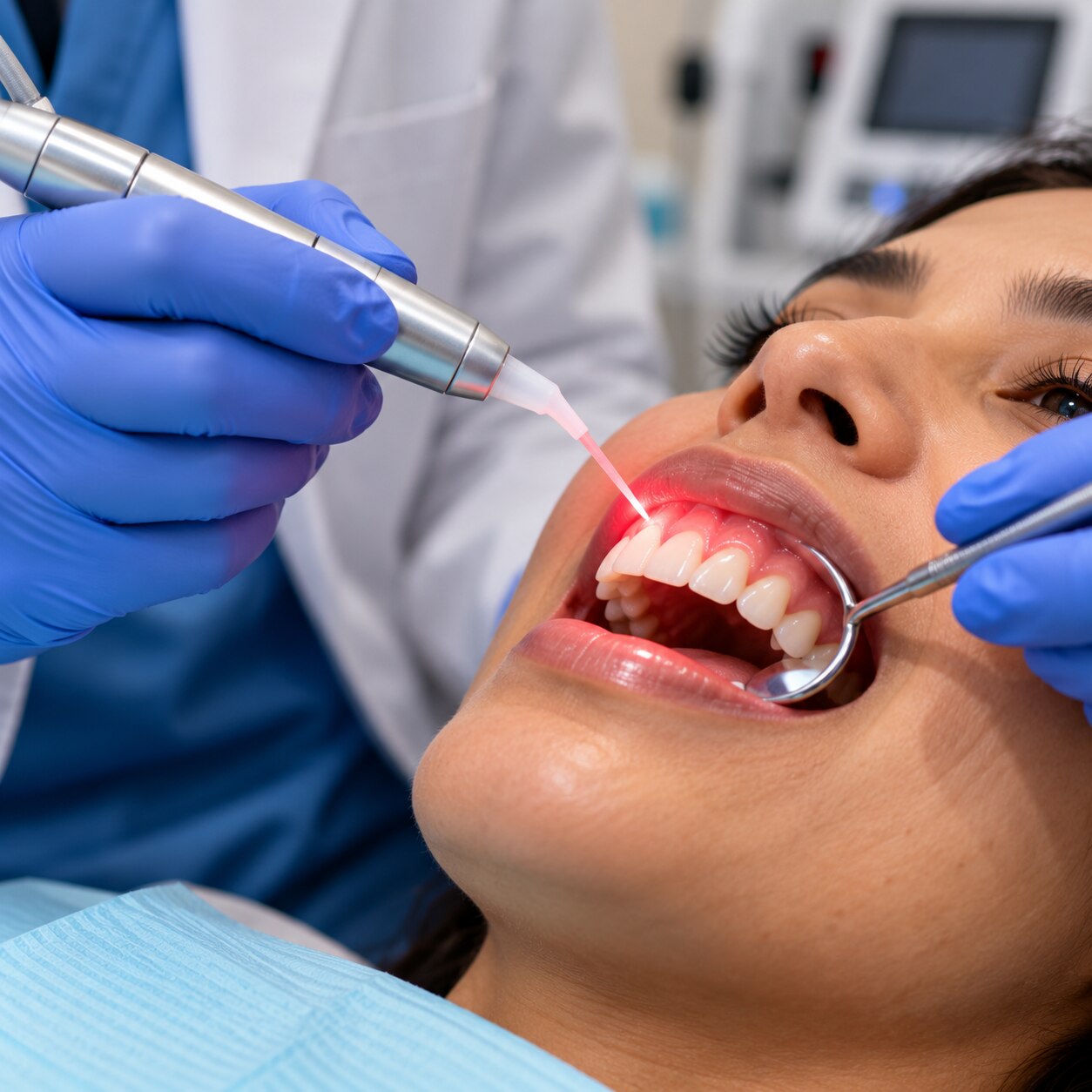
5. The laser is directed into indicated pockets or soft tissue using specific wavelength, power, pulse, and aiming settings. Depending on the equipment and purpose, it can treat inflamed soft tissue, reduce bacterial contamination, reshape tissue, or assist with selected hard-tissue or calculus-related work.
6. The laser gum treatment steps end with irrigation, tissue management, and instructions about brushing, eating, and tenderness. The clinic should schedule post-treatment checks to review healing, bleeding, and pocket measurements rather than treating one session as a permanent cure.
How does laser treatment compare with cleaning, surgery, and antibiotics?
Laser treatment does not automatically replace scaling and root planing, periodontal surgery, or antibiotics. Conventional scaling and root planing mechanically removes plaque and calculus, then smooths contaminated root surfaces so gum tissue can heal.
| Treatment | What it does | When it applies |
|---|---|---|
| Scaling and root planing | Removes deposits and cleanses root surfaces | Fundamental non-surgical care for periodontitis |
| Laser treatment | Targets selected inflamed tissue or bacterial contamination | Adjunct or selected alternative after assessment |
| Flap surgery | Opens the gum for direct access to deep roots and defects | Persistent deep pockets or areas non-surgical cleaning cannot reach |
| Antibiotics | Acts against specific bacterial infections | Particular clinical indications, not routine laser care |
A laser can reduce or vaporize inflamed soft tissue, but it cannot by itself reverse attachment loss or regenerate lost bone. Furcation involvement, severe bone defects, or persistent deep pockets may require flap surgery or regenerative treatment.
Antibiotics are not automatic in gum infection laser treatment. Routine periodontal care depends on debridement, daily brushing and interdental cleaning, and control of risks such as smoking or poorly controlled diabetes. Systemic antibiotics belong in a treatment plan only when the diagnosis provides a clear indication.
Evidence does not establish that every laser protocol produces better long-term periodontal outcomes than conventional instrumentation. Before choosing laser dentistry in Delhi, ask: which part of the treatment is the laser adding, and which part still requires mechanical cleaning? A laser appointment that omits necessary debridement may leave the main cause untreated.
Which gum conditions suit laser care, and what happens after treatment?
Selected inflamed periodontal pockets, certain soft-tissue problems, and cases needing local decontamination or tissue reshaping may suit laser gum care in Delhi after examination. The laser cannot reverse established attachment loss or regenerate missing bone, so it is not a universal cure for periodontitis.
| Condition | Is laser care suitable? | What may be needed instead |
|---|---|---|
| Selected inflamed pockets | Sometimes, as part of planned care | Mechanical cleaning, plaque control, and review |
| Deep persistent pockets or furcation involvement | Not as a standalone solution | Periodontal surgery or regenerative treatment |
| Abscess needing drainage, loose teeth, or severe defects | Usually not the first choice | Drainage, extraction referral, or specialist surgery |
Local anaesthesia can still be necessary, especially when the gum is tender or treatment reaches deeper pockets. Afterward, tenderness, swelling, bleeding, heat-related injury, or temporary tooth sensitivity can occur. Contact the clinic if pain, swelling, or bleeding worsens rather than settles.
After the laser gum treatment steps, the clinic should reassess pocket depths and bleeding, reinforce brushing and interdental cleaning, and schedule periodontal maintenance visits. These checks identify recurrent inflammation before it causes further damage.
Smoking, poorly controlled diabetes, inadequate plaque control, and missed maintenance visits reduce the chance of lasting improvement. One laser appointment cannot compensate for these risks, and one session is not a permanent cure for periodontitis.
What should you confirm before choosing a Delhi dental clinic?
Confirm the exact laser type, its purpose, and the clinical findings supporting its use before you consent. “Laser” alone does not identify the treatment or prove that you need it.
| Item to compare | Proposed laser plan | Conventional or alternative plan |
|---|---|---|
| Exact equipment | Diode, Nd:YAG, or erbium; record the wavelength and intended tissue | Hand instruments, ultrasonic scaler, scaling and root planing, surgery, drainage, or referral |
| Treatment target | Name each tooth, gum area, or periodontal pocket | State which sites receive mechanical cleaning or another procedure |
| Evidence | Record pocket depths, bleeding, recession, mobility, and radiographic bone findings | Explain why these findings support the alternative |
| Expected result | Define the measurement to review and when it will be checked | Use the same measurable review standard |
Ask how many visits the laser gum treatment process in Delhi requires, whether local anaesthetic will be used, and whether scaling and root planing are included. Confirm wavelength-appropriate safety eyewear, aiming control, and precautions against heat injury to nearby tissues.
Ask for the alternatives, itemised fees, maintenance requirements, and a specific follow-up date. A multi-specialty clinic such as Dr Batra's Dental can help coordinate diagnosis, X-rays, gum care, restorative treatment, and surgical referral when one plan involves several services.
Choose laser dentistry in Delhi on the diagnosis, defined treatment sites, and measurable review findings—not on the word “laser” alone.
Related service
Laser Dentistry (for gum treatments) Laser Dentistry (for gum treatments) Experience advanced, minimally invasive gum care with laser dentistry at Dr Batra's Dental. View service → |
Frequently asked questions
How does a dentist diagnose the gum problem before using a laser?
The dentist reviews your symptoms, medicines, diabetes and smoking status, then checks gum pockets, bleeding, tooth mobility, plaque, tartar and bone loss. X-rays can show infection or bone damage below the gumline.
What are the laser gum treatment steps during the appointment?
The dentist numbs the area, removes plaque and tartar, uses the laser to target inflamed gum tissue or bacteria, rinses the area, checks the gum pockets, and gives cleaning and follow-up instructions.
How does laser treatment compare with cleaning, surgery, and antibiotics?
Professional scaling and root planing remove deposits from tooth surfaces and roots. Surgery provides access to deep defects. Antibiotics target selected infections but do not remove tartar. Laser treatment can support gum therapy when the examination shows a suitable indication.
Which gum conditions suit laser care, and what happens after treatment?
Laser care may support treatment for selected gum infections and periodontal pockets after diagnosis. Afterward, you may need gentle cleaning, prescribed medication, a soft-food period, and periodontal reviews to measure healing.
What should you confirm before choosing a Delhi dental clinic?
Confirm the dentist’s periodontal training, the laser’s intended use, whether scaling or surgery is included, the number of visits, total fees, infection-control practices, emergency contact, and follow-up schedule.
Keywords